
Table of Contents
Home Golf Package Guide
Home Golf Simulator Packages: How to Find the Best Value for Your Setup
A home golf simulator package can be one of the easiest ways to build a full indoor setup, but the best package is not automatically the one with the longest feature list or the biggest discount claim. The best package is the one that fits your room, includes the right components, and gives you a clean upgrade path instead of creating expensive compromises later.
That is what makes package buying different from buying a simulator piece by piece. A strong package reduces guesswork, simplifies compatibility, and helps you get to a usable golf room faster. A weak package often hides the real trade-offs in screen quality, projector fit, room logic, or long-term flexibility.
If you want to compare the main commercial routes first, start with
golf simulators,
enclosure packages,
projectors,
and
golf simulator software.
Quick answer
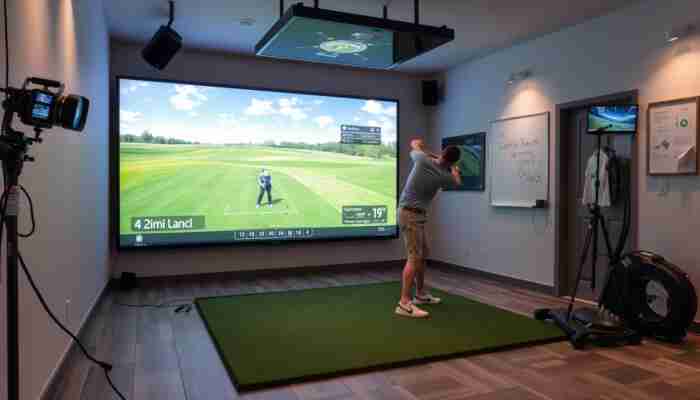
The best home golf simulator package is the one that gives you the right launch monitor, screen, hitting surface, projector path, software fit, and room compatibility for your actual setup. A good package saves time and reduces compatibility mistakes. A bad one bundles the wrong parts together and only looks convenient at first.
What Should a Good Home Golf Simulator Package Include?
A real package should solve a setup problem, not just group products into one checkout flow. That means the included parts should work together cleanly and support the kind of home golf experience you actually want.
A well-built package usually includes…
- a launch monitor matched to the room and use case
- an enclosure or screen path that fits the space
- a hitting surface that supports real use
- software that makes sense for the buyer’s goals
- clear logic behind why the parts are bundled together
A weak package often shows…
- parts that look impressive but do not fit the room
- missing details around projector or screen logic
- a low-quality component hiding inside the bundle
- too little flexibility for future upgrades
- more “included items” than real usable value
The 6 Things That Make a Package a Good Deal
1. The launch monitor fits the actual goal
The launch monitor is usually the center of the whole decision. A package only makes sense when the tracking technology matches what the buyer wants: convenience, realism, portability, advanced feedback, or a more premium room experience.
If you are still unclear on the tracking direction, compare
launch monitors
and
portable launch monitors
before choosing a full package.
2. The room can actually support the package
This is where many packages fail in real life. The bundle may look excellent on paper, but if ceiling height, depth, width, or projector path do not work in your room, it is not a good deal. It is just a convenient mismatch.
3. The screen and enclosure logic is clear
A package should not leave the visual side vague. If the screen, enclosure, and room-protection elements are weak or unclear, the package value drops quickly. Good next comparisons here are
enclosure packages
and
simulator screens.
4. The projector path is realistic
Many buyers underestimate this. If a package depends on a projector setup that does not fit the room, the value is weaker than it appears. In many home builds, the smarter path is to compare
short throw projectors
and
projector mounts
before assuming the included visual setup is correct.
5. The software supports how you will actually use it
A package should include software that fits your goals. Some buyers care most about practice. Others want full course play, family use, or a more immersive visual experience. The more expensive package is not automatically the better one if the software layer does not suit the user.
6. The upgrade path stays open
The strongest package is one that works now and still leaves you room to improve later. That might mean upgrading software, projector quality, hitting mat quality, or room treatment without needing to replace the entire setup.
| Evaluation point | What a good package does | What a weak package does |
|---|---|---|
| Launch monitor choice | Matches goals and room | Looks impressive but fits poorly |
| Room fit | Works in real dimensions | Assumes space the buyer may not have |
| Visual setup | Screen/projector path is clear | Leaves key image questions unresolved |
| Software fit | Matches how the buyer will use it | Adds cost without useful purpose |
| Upgrade path | Leaves room to improve later | Locks the buyer into compromises |
| Overall value | Solves the setup cleanly | Only looks like a deal at checkout |
When a Package Is Better Than Building Piece by Piece
For many buyers, a package is the smarter move because it reduces decision fatigue and lowers the risk of mismatched parts. If you already know the room type and want a faster path to a functional setup, a package can be the best value route.
A package is often better when…
- you want a cleaner buying path
- you want fewer compatibility mistakes
- you want a more complete setup sooner
- you value convenience over customization
A custom build is often better when…
- you know the room in detail
- you want tighter budget control
- you want more selective equipment choices
- you plan to upgrade in stages
What Buyers Usually Miss When Comparing Package Offers
What Type of Package Makes the Most Sense?
Different buyers need different package logic. Some want a simpler starter direction. Others want a more immersive room. Others need something that works especially well in a garage or multi-use space.
| Use case | Best package direction | Why |
|---|---|---|
| First serious home setup | Balanced starter package | Best mix of simplicity and value |
| Garage simulator room | Garage-friendly package path | Room practicality matters most |
| More immersive long-term room | Higher-end complete package | Stronger finished-room experience |
| Buyer who already knows exact constraints | Selective custom route | More precise control over final build |
If you want adjacent package comparisons, good next paths are
indoor golf sim packages with projector and screen,
home simulator setup cost,
and
beginner-friendly simulator selection.
Best Next Step Based on What You Need
If you want to compare simulator directions first
Start with golf simulators before narrowing the package.
If room structure and visual setup matter most
Compare enclosure packages next.
If the room is image-led and projector fit is critical
Review projector paths before locking the package.
If total value and budget are the real decision point
Review the full setup cost guide before choosing a bundle.
FAQ
What is included in a home golf simulator package?
A typical package may include a launch monitor, hitting mat, screen or enclosure path, software, and sometimes projector-related components. The best packages include parts that actually work well together in a real home setup.
Are golf simulator packages worth it?
They can be very worth it when they reduce compatibility mistakes and fit the room correctly. They are less worth it when they bundle impressive parts that do not solve your actual setup needs.
Is a package better than building a simulator piece by piece?
A package is better when you want a faster, cleaner path with fewer compatibility decisions. A custom build is better when you know the room well and want tighter control over the final setup.
How do I know whether a simulator package is a good deal?
Look at room fit, launch monitor logic, screen and projector compatibility, software usefulness, and upgrade potential. A real deal solves more problems than it creates.
What is the biggest mistake people make with simulator packages?
The biggest mistake is buying on bundle language alone. A package is only good value when it fits the room, the goals, and the long-term setup plan.
Should I prioritize the launch monitor or the complete package first?
For many buyers, the launch monitor direction should come first because it influences the whole setup. Once that decision is right, it becomes easier to judge whether the package around it truly makes sense.
Conclusion
A home golf simulator package should not be judged by how many items it includes or how aggressively it is presented as a deal. It should be judged by how well it solves the real setup problem in front of you.
The strongest packages are the ones that match the room, the user, and the long-term plan. When a bundle gives you the right launch monitor, the right room logic, and the right upgrade path, that is real value. Everything else is just packaging.

Lila Chambers is an avid golf enthusiast and author who specializes in writing about indoor golf simulators. With a passion for blending technology and sport, she explores how these innovative systems enhance the golfing experience, making the sport accessible year-round. Lila’s insightful articles provide valuable information for both casual players and dedicated golfers, helping them navigate the world of indoor golf with ease.


Discussion
9 Responses
You raise an important point about the balance between features and actual usability in a simulator package. I remember the excitement of building my own setup and how easily I got caught up in high-end specs. However, it wasn’t until I transitioned from piecemeal components to a more comprehensive package that I truly appreciated how everything worked together.
This guide highlights an essential aspect of investing in home golf simulators—ensuring that the package fits both the physical space and the user’s specific needs. I recently went through the process of choosing a simulator and learned firsthand how overwhelming it can be to sift through the numerous features and options. In my case, prioritizing room layout and future upgrade potential turned out to be critical.
Your insights on home golf simulator packages resonate deeply with anyone who is contemplating the addition of a golf setup to their home. The clarity you provide about not just settling for the most feature-rich option but rather focusing on what genuinely complements one’s space and needs is a critical consideration that many overlook in the excitement of upgrading their indoor golf experience.
I appreciate your thoughts on this—it’s always interesting to see how quickly excitement can lead us to overlook practical needs. When choosing a home golf setup, it’s so important to really think through how it fits into your lifestyle and space. For some, a compact simulator that integrates into a living room might be perfect, while others may have the room for a more extensive setup.
“To help you further refine your decision, check out this curated selection of home golf simulator packages that balance features with your unique space and needs.”
https://golfsimplanet.com/rapsodo
It’s fascinating to see how home golf simulators are evolving from mere novelties into essential tools for both practice and enjoyment. Your emphasis on finding a strong simulator package truly resonates with anyone looking to create a functional and enjoyable indoor golf experience. The nuances you mention—like the importance of screen quality and projector fit—are often overlooked but can significantly impact the overall experience.
It’s great to hear that you share my excitement about the evolution of home golf simulators. The shift from being just a fun gadget to a real tool for improvement is pretty significant. When it comes to screen quality and projector fit, those details can change how immersed you feel in the game.
“I’m glad you found the insights valuable! If you’re interested in exploring some top simulator options that prioritize quality and enhance your indoor golfing experience, check out this link for a closer look.”
https://golfsimplanet.com/UneekorEYEXOLaunchMonitor
This is a really insightful point about how a home golf simulator package should feel complete rather than just appear impressive on paper. I’ve personally gone through the process of piecing together my own setup, and while it was fun at first, I quickly realized the importance of compatibility and future upgrades.
Your insights on home golf simulator packages resonate deeply, especially the emphasis on the importance of establishing a well-rounded setup. In my experience, I found that compatibility is often overlooked when selecting components for a home golf simulator. I initially focused on price and features, but soon discovered that mismatched equipment not only complicated the installation but also affected performance and usability over time.
Your insights on selecting the right home golf simulator package resonate deeply with anyone navigating the often overwhelming array of options available today. I’ve personally experienced the challenge of piecing together a setup, thinking that a DIY approach might yield greater flexibility or savings. However, as you rightly point out, this can lead to frustrating compromises in quality and compatibility.