
Table of Contents
- What Actually Makes a Golf Simulator Work in a Small Space?
- The Best Small-Space Use Cases for Home Golf
- What Type of Product Makes the Most Sense in a Small Space?
- When a Small-Space Setup Is Better Than a Full Simulator Build
- Common Small-Space Mistakes
- What to Do If Your Room Is Too Tight for a Traditional Simulator
- Best Next Step Based on Your Space
- FAQ
- Conclusion
Small-Space Home Golf Guide
Best Golf Simulator for Small Spaces: Smart Home Practice Setups That Actually Fit
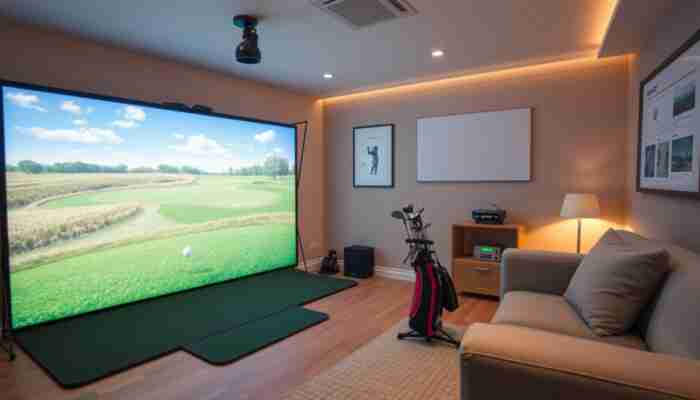
A small room does not automatically rule out indoor golf practice. The real question is not whether you can fit a traditional full simulator build into the space. The real question is which kind of golf simulator setup still gives you useful, repeatable practice without turning the room into a cramped compromise.
That is why the best golf simulator for a small space is usually not the biggest, most immersive, or most feature-heavy option. In tighter rooms, apartments, spare bedrooms, offices, and garage corners, the smartest setup is the one that balances room fit, practice value, setup simplicity, and realistic long-term use.
If you are comparing adjacent home-golf paths too, also see
portable launch monitors,
ball-free home golf options,
simulator accuracy,
and
beginner-friendly setup choices.
Quick answer
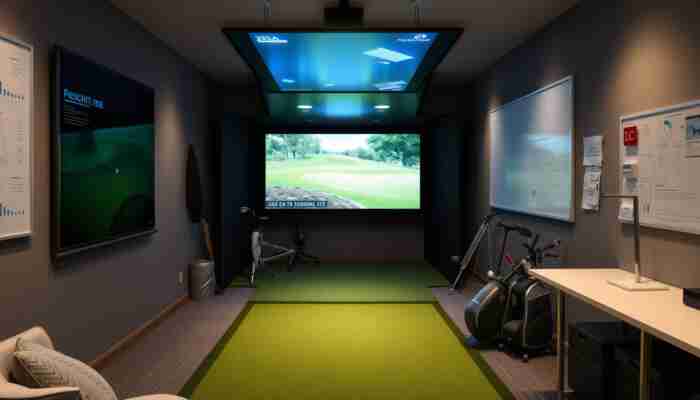
The best golf simulator for a small space is one that gives you real practice value without demanding a full dedicated simulator room. In most compact home setups, that usually means a more flexible, lower-footprint system, cleaner room planning, and fewer unnecessary components.
Best fit for compact home practice
Garmin Approach R10 DIY Golf Simulator Package
If your main goal is real home practice in limited space, this is one of the smartest products to highlight. It makes far more sense for small rooms than pushing a massive full-room build that the space cannot support well.
- better suited to compact home practice than a full multi-bay style setup
- gives you real feedback without demanding a huge dedicated room
- more practical for flexible spaces, spare rooms, offices, and tighter garages
- stronger fit for people who want useful reps, not a giant showpiece build
What Actually Makes a Golf Simulator Work in a Small Space?
A small-space simulator succeeds when it respects the room instead of fighting it. That means fewer oversized ambitions and more attention to what the room can handle safely and comfortably.
In practical terms, the best compact setups usually depend on:
What helps in a small room
- compact launch-monitor-first thinking
- lower-friction setup and teardown
- careful screen or net choice
- practical room flow
- repeatable use without constant adjustment
What usually hurts small-space setups
- trying to force a full simulator room into a tight area
- oversized enclosure expectations
- too many components for the available room
- ignoring flexibility in multi-use spaces
- buying by hype instead of room constraints
The Best Small-Space Use Cases for Home Golf
Apartment or condo
In apartments, the best path is usually not a giant immersive build. It is a simpler system that respects limited depth, shared walls, and room flexibility. This is where compact launch-monitor-led practice or even ball-free alternatives can make more sense than a traditional full simulator concept.
Spare room or office
A spare room can be a strong indoor golf space if the setup does not overwhelm the room. Here, the smartest move is usually a practical build with clear floor flow and the ability to keep the space usable.
Garage corner or partial garage build
Garages often offer more flexibility, but even then, the best result comes from controlling scale. A smaller, cleaner setup can outperform a poorly planned oversized build that becomes annoying to use.
| Space type | Best setup direction | Main reason |
|---|---|---|
| Apartment / condo | Compact or lower-impact setup | Noise, flexibility, tighter footprint |
| Spare room / office | Compact home-practice build | Keeps the room practical |
| Garage corner | Flexible practice-led setup | Best balance of room freedom and usability |
What Type of Product Makes the Most Sense in a Small Space?
Portable launch-monitor-first setups
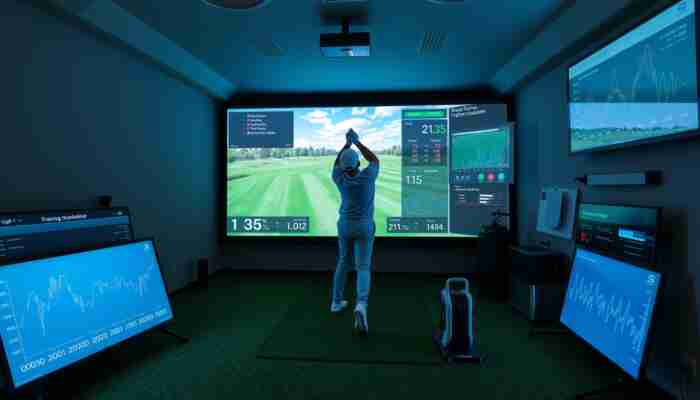
For many people, this is the smartest answer. It gives you useful swing and shot feedback without forcing a full room transformation. This is why compact home-practice products are often the best match for smaller spaces.
Retractable screen solutions
In multi-use rooms, a retractable screen can make much more sense than a permanent enclosure. It keeps the room flexible and reduces the feeling that the simulator has taken over the space.
Smart upgrade for multi-use rooms
HomeCourse ProScreen 180 Retractable Golf Simulator Screen
If your room still has to function as a room, this is the kind of product worth highlighting. A retractable screen is a much better fit for shared spaces than pretending every small room should become a permanent simulator bay.
When a Small-Space Setup Is Better Than a Full Simulator Build
A full simulator room sounds appealing, but in many small homes it is simply the wrong solution. A compact, more flexible setup often creates more real practice value because it is easier to use, easier to maintain, and easier to keep as part of normal daily life.
This is especially true if your goal is:
- regular home practice
- quick sessions before or after work
- basic shot feedback without a huge room build
- a setup that can coexist with normal home use
Common Small-Space Mistakes
What to Do If Your Room Is Too Tight for a Traditional Simulator
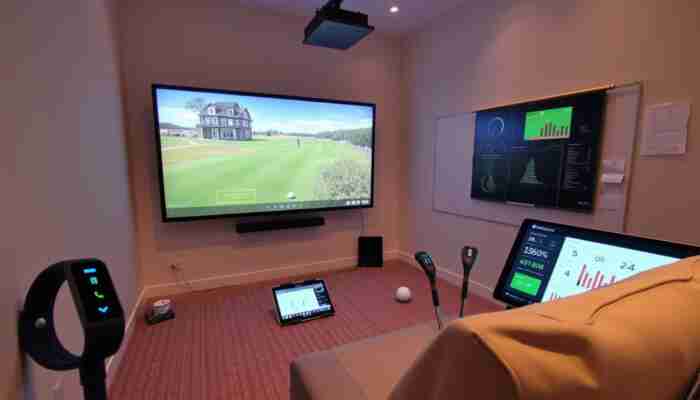
If a full setup clearly does not fit, do not force it. That usually leads to a worse experience, not a better one.
The smarter alternative is usually one of these:
- a compact launch-monitor-led practice setup
- a retractable screen path for multi-use rooms
- a ball-free or lower-impact indoor golf option
- a phased setup that starts simple and grows later
If that sounds closer to your situation, also look at
no-ball home golf simulator options
and
portable launch monitors.
Best Next Step Based on Your Space
If you want the strongest small-space practice option
Check the Garmin Approach R10 DIY Golf Simulator Package.
If your room must stay flexible
See the HomeCourse retractable screen.
If you want the simplest compact route
Compare portable launch monitors first.
If a real-ball setup still feels too difficult
Look at ball-free home golf alternatives.
FAQ
What is the best golf simulator for a small space?
The best option is usually the one that gives you useful practice without demanding a full dedicated simulator room. In many small home setups, compact launch-monitor-led solutions are the smartest fit.
Can you use a golf simulator in an apartment?
Yes, but the best path is usually a smaller, simpler setup that respects room limits, flexibility, and everyday living needs rather than trying to force a full simulator room into the apartment.
Is a retractable screen better for a small room?
In many cases, yes. A retractable screen is often a much better fit for multi-use spaces because it keeps the room more flexible and less dominated by simulator equipment.
What is the biggest mistake with a small-space golf simulator?
The biggest mistake is trying to build a large dedicated-room setup in a space that clearly cannot support it well. That usually creates a worse experience than a smaller, smarter practice-first solution.
Is a small-space setup still good for practice?
Yes. A compact setup can still be excellent for regular home practice if it is easy to use, gives useful feedback, and matches the room well.
What should I choose if my room is really too small?
If the room is too tight for a traditional simulator, the best move is often a compact launch-monitor-led setup, a retractable-screen solution, or even a ball-free indoor golf option.
Conclusion
A small space does not have to end the idea of home golf practice. It just changes what the smartest setup looks like.
The best golf simulator for a small space is not the one that tries to imitate a giant dedicated room. It is the one that fits your home, supports real practice, and makes indoor golf easy enough to use again and again.

Ethan Reynolds is a passionate writer and enthusiast in the world of indoor golf simulators. With a keen eye for technology and a deep understanding of golf dynamics, he explores the intersection of sports performance and innovative simulation tools. Through his engaging articles, Ethan provides valuable insights and tips for golfers at all levels, helping them enhance their game while enjoying the convenience of home-based training.


Discussion
12 Responses
The exploration of golf simulators for small spaces is such a timely conversation, especially as urban living continues to be the norm for many of us. I love how these simulators not only cater to our passion for golf but also adapt to our changing lifestyles. It’s fascinating to think about how technology can turn what might feel like a limitation—having less space—into an opportunity for creativity and innovation in our practice routines.
You’ve brought up such a great point about urban living and how those tighter spaces push us to think outside the box! It’s wild to consider how technology is reshaping our experiences, especially with something as traditional as golf. The fact that we can now set up simulators in a spare room, garage, or even a corner of a living room changes the whole game—literally.
It’s fascinating to see how technology has evolved to accommodate golfers who are limited by space. Your insights about balancing room fit with practice value really resonate with me.
It’s great to hear that my thoughts on the intersection of technology and space for golfers struck a chord with you. This topic opens up some interesting angles. When we consider how technology helps those limited by space, we also have to address whether these solutions genuinely enhance the game or if they just substitute real practice with something that may feel convenient.
This is such a timely topic! As someone who lives in a small apartment, I’ve struggled with finding room for my golf practice without sacrificing space for other activities. It’s interesting how innovations in technology allow for portable and compact setups that still offer a great experience. I recently tried a compact simulator that actually fits in my living room corner; it has really changed my game.
Your insights on navigating small-space golf setups resonate with many urban dwellers who face similar challenges. I particularly appreciate the emphasis on balancing practicality with the desire for a comprehensive practice experience.
I appreciate the focus on practicality in finding the right golf simulator for small spaces. It’s so easy to get caught up in the allure of all the bells and whistles that come with larger setups, but as you pointed out, the key is balancing functionality with available space.
It’s cool to see a post dedicated to the unique challenges of fitting golf practice into smaller spaces. I really resonate with the idea that just because our rooms are cozy, it doesn’t mean we can’t find meaningful ways to practice. I often find myself daydreaming about having a designated golf room, but the reality is, my apartment in the city is about as spacious as a shoebox!
I totally relate to the challenge of mixing golf practice with limited space. I recently turned a tiny corner of my living room into a makeshift simulator, and it’s surprising how much you can actually do in what feels like a shoe box! I found that a compact launch monitor paired with a hitting net really helped maximize my practice without overwhelming the vibe of the room.
This is such a relevant topic for so many of us trying to enjoy our favorite pastimes in less-than-ideal spaces! I completely agree that optimizing a small area for golf practice is all about balance. I’ve experimented with a few setups in my own apartment, and it’s interesting how much thought goes into what you actually need versus what you want in terms of features.
The exploration of golf simulator setups for small spaces is a topic that truly resonates with many of us who love the game but face space constraints in our homes. I appreciate the focus on finding the right balance between functionality and practicality when it comes to indoor golfing. My experience mirrors this sentiment; I transitioned from a traditional golf practice routine at a course to creating a mini setup in my home office due to time and travel limitations.
I really appreciate your perspective on golf simulators for small spaces! It’s so true that many players assume a full simulator setup is out of the question if they don’t have a dedicated space, but there are so many creative solutions out there. I’ve personally found that even a compact setup can provide a surprisingly authentic experience.