Table of Contents
- What “No Balls Required” Really Means
- Who a No-Ball Golf Simulator Is Best For
- Where No-Ball Simulators Fall Short
- No-Ball Simulator vs Traditional Home Simulator
- How to Choose the Right No-Ball System for Home
- Common Mistakes with No-Ball Home Golf Systems
- Best Next Step Based on What You Want
- FAQ
- Conclusion
No-Ball Home Golf Guide
No-Ball Golf Simulators for Home: What They Are and Who They Fit
A no-ball golf simulator is not the same thing as a traditional home golf simulator. That distinction matters. Most full indoor golf simulator setups still use a real golf ball, a hitting area, and launch-monitor-style tracking. A no-ball system is a different category built around motion tracking, controller-style swings, or simplified at-home golf experiences that do not require real ball striking.
For the right user, that can be a big advantage. Ball-free systems are often easier to use in tight spaces, less intimidating for beginners, and more practical for quick sessions at home. But they also come with trade-offs, especially if your goal is realistic shot data and full-ball practice.
If you are still deciding between a ball-free system and a full setup, compare
golf simulators,
portable launch monitors,
VR golf simulator options,
and
training aids
before choosing the direction that fits your home best.
Quick answer
A no-ball golf simulator for home is best for people who want a simpler, safer, quieter, and more compact way to practice or play indoors. It usually fits beginners, families, apartments, casual players, and golfers who want fast setup and easy use. It is usually not the best choice for players who want full real-ball feedback, launch data, and a true simulator-room experience.
What “No Balls Required” Really Means
In this category, “no balls required” usually means the system tracks your motion without needing a real golf ball at impact. Depending on the product, that may involve a sensor-equipped club substitute, a compact swing trainer, a motion-tracking device, or a software-driven virtual golf experience built around simplified input.
That makes these systems fundamentally different from traditional home simulators built around real-ball contact. The benefits are obvious: less mess, less room risk, less noise, and fewer setup demands. But the trade-off is just as important: you are not getting the same level of real strike interaction that a standard simulator delivers.
A no-ball system usually offers…
- lower room risk
- quicker sessions
- easier family use
- better fit in smaller spaces
- less setup friction
A no-ball system usually gives up…
- true ball-strike realism
- full launch feedback
- more advanced shot analysis
- closer simulation of real impact
- the full feel of a complete home simulator room
Who a No-Ball Golf Simulator Is Best For
Beginners who want a less intimidating start
Ball-free golf systems can be a very approachable entry point. They lower the pressure of striking a real ball indoors and make it easier for new players to focus on swing rhythm, body movement, and basic engagement with virtual golf.
Families and casual home users
If the goal is fun, convenience, and easy access at home, these systems make a lot of sense. They are usually easier to share, faster to start, and less risky in everyday living spaces.
Small spaces and multi-use rooms
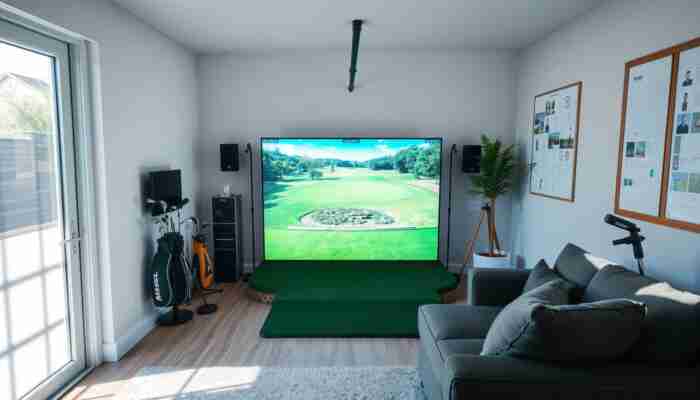
One of the strongest reasons to choose a no-ball setup is room practicality. If you do not have the ceiling height, ball-safe environment, or dedicated simulator room for a full build, a ball-free setup may be the only realistic way to bring golf indoors.
Golfers who want short, frequent sessions
Some players do not need a full simulator room. They need something they can use for fifteen minutes without setup hassle. A no-ball system can be strong when speed and convenience matter more than maximum realism.
| User type | Why no-ball can work | Main trade-off |
|---|---|---|
| Beginner | Easy entry and lower intimidation | Less real-ball feedback |
| Family / casual user | Fun and easy to share | Less serious training depth |
| Apartment / small room user | More realistic room fit | Reduced simulator realism |
| Serious golfer wanting quick reps | Convenient supplementary use | Not a full replacement for real-ball sim work |
Where No-Ball Simulators Fall Short
A no-ball simulator can be genuinely useful, but it is still important to be honest about what it does not do. It does not recreate real impact in the way a traditional home simulator does. That means the feedback is often more abstract, more game-like, or more movement-based than truly ball-flight-based.
If your goal is serious shot shaping, launch conditions, carry gapping, club delivery analysis, and full-ball strike realism, a standard simulator or launch-monitor-led practice setup is usually the better path.
Important distinction
Most serious home golf simulators still use a real golf ball. A no-ball system is better understood as a different category of indoor golf experience, not as a direct one-to-one replacement for a full simulator room.
No-Ball Simulator vs Traditional Home Simulator
| Comparison point | No-ball simulator | Traditional home simulator |
|---|---|---|
| Real golf ball required | No | Usually yes |
| Space requirements | Lower | Higher |
| Safety / room risk | Usually easier | Needs proper room planning |
| Ball-strike realism | Lower | Higher |
| Ease of use | Higher | Depends on setup |
| Best for | Convenience, fun, compact use | Serious practice and realism |
| Long-term path | Alternative or starter option | Full home simulator path |
How to Choose the Right No-Ball System for Home
Start with the room, not the product
The strongest reason to choose a ball-free simulator is usually room practicality. If you are using a living room, spare room, office, or apartment, the room should define the buying path first.
Decide whether you want practice or entertainment first
Some no-ball systems are better as casual play devices. Others are better as light practice tools. They are not all trying to solve the same problem, so this distinction matters.
Be honest about realism expectations
If you already know you want real-ball indoor practice, do not force a no-ball system to fill that role. It is usually smarter to move toward
full golf simulators
or
portable launch monitors
instead.
Consider VR and adjacent immersive options
Some buyers interested in no-ball home golf are really looking for a more immersive but less room-intensive digital experience. In that case,
VR-compatible golf simulators
may be more relevant than a traditional home sim.
A smarter decision order
- Measure the room
- Decide whether real-ball practice matters
- Choose between convenience and realism
- Pick the category that fits your actual use
- Leave room to upgrade later if needed
Common Mistakes with No-Ball Home Golf Systems
Best Next Step Based on What You Want
If you actually want a full home simulator
Start with full golf simulators instead of no-ball alternatives.
If real-ball feedback matters more than a full room build
Compare portable launch monitors first.
If immersion matters more than real-ball realism
Explore VR-compatible golf simulator options.
If you are still very early in the buying journey
Read the beginner guide before choosing a category.
FAQ
What is a no-ball golf simulator?
A no-ball golf simulator is a home golf system that tracks motion without requiring a real golf ball at impact. It usually focuses on convenience, compact use, and easier indoor access rather than full real-ball simulation.
Do indoor golf simulators need balls?
Most traditional home golf simulators do. Ball-free systems are a different category designed to avoid real golf ball use, usually with different trade-offs in realism and feedback.
Are no-ball golf simulators good for practice?
They can be useful for convenient repetition, body movement, rhythm, and casual at-home golf sessions. They are less ideal when you want true ball-strike realism and deeper shot analysis.
Who should buy a no-ball golf simulator for home?
They fit beginners, families, small-space users, and golfers who care most about simplicity, low mess, and quick sessions at home.
When is a traditional home simulator the better choice?
A traditional simulator is better when you want real-ball tracking, more realistic shot feedback, structured practice, and a setup closer to true simulator-room performance.
What is the biggest mistake with no-ball golf systems?
The biggest mistake is expecting them to behave like full real-ball simulators. They work best when they are chosen for the reasons they actually solve: convenience, space, safety, and easier indoor use.
Conclusion
No-ball golf simulators for home can be genuinely useful, but only when they are understood correctly. They are not simply regular simulators without golf balls. They are their own category of indoor golf experience built around convenience, accessibility, and easier home compatibility.
For the right buyer, that is exactly the point. If you want low-friction indoor golf in a smaller space, a ball-free system may be the better match. If you want full practice realism and real-ball feedback, a traditional home simulator is still the stronger path.

Megan Thompson is an accomplished author and expert on indoor golf simulators, dedicated to helping golf enthusiasts enhance their game at home. With a passion for technology and sports, she explores the latest advancements in simulation equipment and offers insightful tips for players of all skill levels. Her engaging writing not only demystifies the complexities of indoor golf but also highlights its benefits for training and recreation, making her a trusted voice in the industry.
Discussion
8 Responses
The distinction between no-ball and traditional golf simulators is quite fascinating and really highlights how technology is reshaping our experience with the game. I’ve often found that the intimidation factor can hold many potential golfers back, especially newcomers who may feel overwhelmed by the idea of using real equipment in a dedicated space. No-ball systems seem like a wonderful gateway, allowing people to enjoy the sport in a more laid-back manner, which could really benefit the overall growth of golf.
Your breakdown of no-ball golf simulators offers a fascinating perspective on this evolving niche in the world of golf technology. It’s interesting to consider how these systems are reshaping the way we engage with the sport, particularly for those who may feel daunted by the traditional elements of golf practice.
This distinction between no-ball systems and traditional simulators is quite enlightening. Having recently explored both options for my home setup, I can relate to the convenience that a no-ball simulator offers, especially in smaller living spaces. The appeal for beginners is also significant; it removes the intimidation factor of hitting real golf balls, making practice more accessible.
You make a great point about the convenience of no-ball systems, especially in smaller spaces. It’s refreshing how they create a more relaxed environment for beginners who might feel overwhelmed by the idea of hitting real golf balls indoors. I’ve noticed that taking away that intimidation factor not only fosters confidence but makes practice feel more like fun and less like a chore. Plus, the ability to focus on mechanics without the worry of mess or damage is such a game changer. It’s interesting to see how technology is reshaping our experience of golf, making the sport more approachable for everyone. What kind of setup are you using? It’d be cool to hear what aspects you’ve found most beneficial.
I’m glad to hear you found the distinction helpful! If you’re interested in exploring some great no-ball simulator options, check out this link for more details and tips.
https://golfsimplanet.com/FlightScopeMevoPractice
You really captured the essence of why no-ball systems are so appealing. The intimidation factor can be a real barrier for beginners, and it’s nice to see how these setups can make the whole experience more inviting. I think making practice feel like fun rather than a chore is such an important piece in encouraging people to engage more with golf.
This is an interesting take on no-ball golf simulators versus traditional setups. I can see the appeal, especially for those with limited space or those just starting out. I tried a no-ball system at a friend’s place, and while it was fun and stress-free, I did miss the real feedback of hitting an actual ball.
Your breakdown of no-ball golf simulators really highlights some important distinctions that often get overlooked. As someone who recently transitioned from a full simulator to a no-ball system due to space constraints, I’ve found the ease of setup and accessibility truly liberating. It makes it so much easier to fit in short practice sessions during a busy day, which I appreciate.
This blog post about no-ball golf simulators really highlights an intriguing development in the world of home golf practice. I’ve always found the accessibility of different training aids and technology fascinating, especially when they cater to the diverse needs of golfers at various skill levels. The distinction between traditional simulators and no-ball systems is certainly a thoughtful one, and it opens up a lot of interesting dialogues about what makes for effective practice.