
Table of Contents
- Why Indoor Golf Simulators Help You Improve Year-Round
- What Actually Makes a Golf Simulator Good for Practice?
- What Type of Indoor Simulator Is Best for Skill Improvement?
- How to Use a Golf Simulator for Real Practice Instead of Random Play
- What Buyers Often Get Wrong About Year-Round Simulator Improvement
- Best Next Step Based on Your Practice Goal
- FAQ
- Conclusion
Indoor Golf Practice Guide
Indoor Golf Simulators for Year-Round Skill Improvement
A golf simulator can be one of the most effective ways to keep your game moving forward when outdoor practice is inconsistent, inconvenient, or simply unavailable. But real year-round improvement does not come from owning a simulator alone. It comes from choosing a setup that actually helps you practice the right way, often enough, and with feedback you can trust.
For golfers who want to improve more consistently, an indoor golf simulator creates something that outdoor practice often cannot: reliable reps, immediate feedback, and a training environment you can use all year long.
If you are still deciding which kind of home practice setup makes the most sense, start with
golf simulators,
portable launch monitors,
simulator screens,
and
golf simulator software
first.
Quick answer
The best indoor golf simulator for year-round skill improvement is one that helps you practice regularly, clearly, and with useful feedback. For many golfers, that means a home setup built around the right launch monitor, room fit, software, and practice routine — not just the most expensive simulator package.
Why Indoor Golf Simulators Help You Improve Year-Round
The main advantage of an indoor golf simulator is not that it replaces outdoor golf completely. It is that it removes long gaps in practice. When practice becomes easier to access, improvement becomes easier to sustain.
That is why simulators matter so much for year-round development. They reduce weather friction, travel friction, scheduling friction, and the inconsistency that often slows down skill growth.
A good simulator improves training by…
- making practice more frequent
- giving immediate shot feedback
- helping structure practice sessions
- turning spare time into useful reps
- keeping progress moving even in off-seasons
A weak setup often fails because…
- the room is awkward to use
- the feedback is too unclear
- the setup takes too much effort every session
- the simulator feels more like a gadget than a tool
- practice is not built into a repeatable routine
What Actually Makes a Golf Simulator Good for Practice?
1. Reliable launch data
If the simulator does not give feedback you trust, practice quality drops fast. That is why the launch monitor is often the most important practice decision in the whole setup.
For many home golfers, it makes sense to compare
portable launch monitors
first before committing to a more complex room build.
2. Easy room access
A practice simulator only works if you actually want to use it. That means room flow matters. The easier it is to step in, hit shots, and start working, the more valuable the simulator becomes over time.
3. A visual setup that supports focus
A full screen and projector setup can improve immersion, but only if it fits the room well. If the room can support it, compare
simulator screens
and
short throw projectors
before building the visual side of the practice space.
4. Practice-friendly software
Software matters because it shapes how you interact with your own improvement. The best practice software is not just entertaining. It helps you repeat, compare, track, and structure training better.
5. A setup you can sustain long term
A better practice system is one you can live with for years. That means the best simulator is often the one with the strongest balance of cost, room fit, ease of use, and upgrade flexibility.
| Practice Factor | Why It Matters | Common Problem |
|---|---|---|
| Launch data | Builds trust in the feedback | Practicing without confidence in the numbers |
| Room access | Makes practice frequent | Setup friction killing consistency |
| Visual clarity | Improves focus and immersion | Weak screen/projector fit |
| Software | Supports structured training | More entertainment than improvement |
| Long-term fit | Keeps the simulator useful over time | Overspending on the wrong type of build |
What Type of Indoor Simulator Is Best for Skill Improvement?
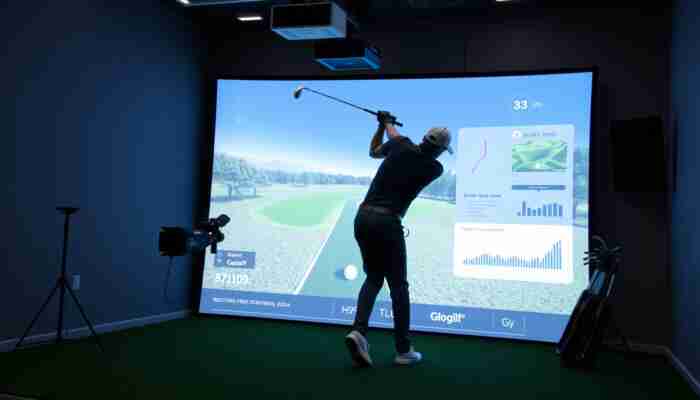
A simple practice-first setup
This is often the best option for golfers whose main goal is to hit more balls, get better feedback, and build a repeatable training habit. It keeps the focus on improvement instead of turning the room into a giant project too early.
A balanced home simulator room
This is often the strongest value path for year-round development. It combines enough realism, enough feedback, and enough immersion to make practice enjoyable without forcing a fully premium build from day one.
A premium dedicated simulator room
This can be excellent for year-round improvement, but only when the room, budget, and long-term commitment already justify it. For many golfers, this is something to grow into rather than start with immediately.
| Practice Goal | Best Direction | Why |
|---|---|---|
| Just practice more consistently | Practice-first setup | Lower friction, easier repetition |
| Train seriously at home | Balanced home simulator room | Best mix of realism and repeat use |
| Build a long-term premium golf room | Dedicated premium simulator room | Best for a polished full environment |
How to Use a Golf Simulator for Real Practice Instead of Random Play
One of the biggest hidden problems with indoor golf setups is that they become entertainment rooms instead of training tools. That is why the practice model matters so much. The simulator should make it easier to train intentionally, not just hit balls endlessly without structure.
A simple year-round simulator practice sequence
- Warm up with a short, repeatable block
- Work on one skill focus at a time
- Use launch data to confirm trends
- Mix training with simulated play, not only random shots
- Track progress over weeks, not just single sessions
What Buyers Often Get Wrong About Year-Round Simulator Improvement
Best Next Step Based on Your Practice Goal
If you want the easiest path into serious home practice
Compare portable launch monitors first.
If you want to compare full simulator directions
Start with golf simulators and narrow the setup type first.
If budget is your biggest obstacle
Review the full home golf simulator cost guide before building the room.
If you are ready to build a cleaner long-term setup
Look at installation options so the room works the right way from the start.
FAQ
Is a golf simulator good for practice?
Yes, especially when the setup gives reliable feedback and makes regular practice easier. A good simulator reduces practice gaps and helps turn indoor time into useful repetition.
Can an indoor golf simulator really improve your game?
It can, but improvement comes from consistent use and structured training. The simulator is a tool. Real progress comes from how you practice with it.
What is the best golf simulator for year-round practice?
The best simulator for year-round practice is usually the one that fits your room, your budget, and your training style. For many golfers, a well-balanced setup is more effective than an overbuilt one.
Do I need a full simulator room to practice effectively at home?
No. Many golfers improve very effectively with a simpler practice-first setup. A full room is valuable when the space, budget, and long-term use all justify it.
What matters more for practice: software or hardware?
Both matter, but the simulator becomes much more useful when software supports real practice instead of only entertainment. Hardware creates the data. Software shapes how you use it.
What is the biggest mistake with year-round indoor golf practice?
The biggest mistake is confusing access with improvement. Having a simulator available is helpful, but real progress still depends on structured, repeatable practice.
Conclusion
Indoor golf simulators can absolutely support year-round skill improvement, but the real value is not in the machine itself. It is in what the setup allows you to do consistently — practice more often, train with more clarity, and stay connected to your game when outdoor golf is less available.
The smartest move is to choose a simulator that fits your room, your budget, and the kind of practice you actually want to sustain. That is what turns indoor golf from a nice feature into a real performance tool.

Abigail Turner is a passionate writer and golf enthusiast specializing in indoor golf simulators. With a keen eye for detail and a deep understanding of the technology behind these platforms, she provides insightful content that helps players maximize their indoor golfing experience. Abigail’s engaging articles cover everything from equipment reviews to tips for improving one’s game, making her a go-to resource for both beginners and seasoned players alike.
Discussion
28 Responses
The insights shared in the Indoor Golf Practice Guide resonate deeply with my experiences as a golfer navigating the challenges of consistent practice. The benefits of an indoor golf simulator, as mentioned, truly cannot be overstated, especially for those of us living in regions where the weather can be unpredictable. Having the ability to step into a controlled environment not only allows for year-round practice but also instills a certain level of discipline that outdoor practice sometimes lacks.
You touched on a crucial aspect of golf practice with your insights on indoor simulators. The concept of reliable reps paired with immediate feedback resonates strongly with me; it’s something I’ve found to be transformative in my own game. As someone who used to rely heavily on outdoor practice, I appreciate how indoor setups can eliminate many of the variables—like weather and course conditions—that often disrupt progress.
I really appreciate your thoughts on the value of indoor simulators. It’s great to hear how you’ve found that reliable repetition, combined with immediate feedback, has made such a difference in your game. When I first tried an indoor setup, I was surprised by how much it simplified things. Gone were the days of worrying about wind direction or uneven lies.
Thank you for sharing your experience! If you’re looking to enhance your practice even further, check out this resource on top indoor simulators that can help you make the most of your game.
https://golfsimplanet.com/UneekorSwingOptixCamerasSoftware
Indoor simulators have definitely changed the game for many of us, haven’t they? It’s fascinating how eliminating the distractions of outdoor conditions can actually help us focus more on our swing mechanics. I remember the first time I tried one — it felt like a lightbulb moment for my understanding of the fundamentals.
This guide really hits the mark! I’ve found that my indoor simulator not only helps with skill retention during off-seasons but also challenges me to work on specific aspects of my game, like consistency in my swing. The immediate feedback you mentioned is invaluable; it’s like having a coach with you every session. Plus, I love how tech has made golf more accessible, allowing us to practice in ways that were simply not possible before. Have any of you experimented with different setups or software? I’m curious to hear how they’ve shaped your practice routines!
Your insights on the significance of choosing the right golf simulator setup resonate deeply, particularly as we see more golfers making the leap into indoor practice. The diversity in available technology—from high-end simulators that track every nuance of a swing to more budget-friendly options—can feel overwhelming at times. I’d like to share a personal experience that underscores your point about the importance of reliable feedback.
You bring up an interesting point about the overwhelming choices in golf simulator technology. It can definitely be a maze out there, especially for those new to indoor practice. Your mention of reliable feedback really strikes a chord. I think finding a setup that gives you consistent and accurate data can truly elevate your game.
Thank you for sharing your thoughts! If you’re looking for a guide to help navigate the different golf simulator options and find the right fit for your needs, check out this resource that breaks down everything you need to know.
https://golfsimplanet.com/ProTeeUnitedVXProtector
I really appreciate your insights on the importance of reliable reps and feedback in improving our golf game. Having used an indoor simulator during the off-season, I found it incredibly beneficial for maintaining my swing mechanics and consistency. The immediate data on my shots allowed for quick adjustments that I sometimes struggle to make on the course, especially during practice in less-than-ideal weather conditions.
I really appreciate how you highlighted the importance of not just having a golf simulator but also choosing the right setup for meaningful practice. It’s fascinating to think about how technology has transformed our approach to sports, especially golf, where every stroke can be fine-tuned with the right feedback.
It’s fascinating to see how indoor golf simulators are revolutionizing the way we approach practice. The emphasis you placed on having a reliable setup that aids in consistent skill improvement is incredibly salient. From personal experience, I’ve found that the greatest barrier to improvement for many golfers is the variability of outdoor conditions—things like weather, course accessibility, and even seasonal changes can dramatically impact our ability to practice effectively.
Your exploration of indoor golf simulators really resonates with me, especially the emphasis on both reliable repetitions and immediate feedback. As someone who has faced the fluctuations of outdoor practice due to weather and time constraints, I can attest to the transformational potential of these simulators for consistent skill improvement.
The insights shared in your guide resonate deeply with any golfer striving for consistent improvement, particularly in light of the various challenges that outdoor practice presents. It’s fascinating to consider how the evolution of technology in golf, especially through indoor simulators, has transformed the way we approach our training routines.
I found your insights on indoor golf simulators really refreshing! The idea that a setup can significantly influence our practice habits really resonates with me. I’ve often struggled with consistency in my game, especially during those colder months when getting out to the course feels like a distant dream.
I get where you’re coming from. Winter can be tough for keeping your swing consistent, especially when you can’t easily hit the greens. That’s where simulators really shine — they not only help you stay sharp during those cold months, but they also offer features that can enhance your game. I like to think of them as a tool for finding your rhythm at home. Have you tried any specific drills or courses on your simulator that have helped? It’d be cool to hear what’s worked for you in staying engaged with your practice.
This post offers valuable insights regarding the role of indoor golf simulators in improving one’s game throughout the year. I resonate deeply with the sentiment that consistent and reliable practice is essential to skill development, especially when outdoor conditions can be prohibitive due to weather or other commitments.
Your insights on the importance of choosing the right indoor setup for effective practice are spot on. I’ve experienced firsthand how inconsistent outdoor conditions can disrupt skill development, especially in areas like my short game where precision is key.
Your insights on the importance of a well-chosen indoor golf simulator resonate deeply with me. Having struggled to make consistent improvements during erratic weather, I can appreciate the need for tools that provide dependable feedback and foster skill enhancement.
You’ve raised some important points about the role of indoor golf simulators in skill development. As someone who has tried both outdoor practice and simulator sessions, I can attest to the difference in quality and consistency when using a simulator. The immediate feedback it provides is invaluable—it allows me not only to correct my swing in real-time but also to track my progress over time more accurately.
I really appreciate how you’ve highlighted the importance of proper setup and consistent practice with indoor golf simulators. It’s true that while owning a simulator can be a fantastic tool, the real key is how we utilize it to genuinely improve our game. I’ve noticed that when I’m outdoors, there’s often a difference in my focus. The distractions of the environment can make it hard to concentrate on the mechanics of my swing.
You bring up a valuable point about the differences in focus between indoor and outdoor practice. It’s interesting how the outdoor setting can introduce so many variables that pull our attention away from what we’re trying to perfect in our swing. Indoor simulators certainly offer a controlled environment, which can make it easier to hone in on mechanics without distractions.
I appreciate your insights on the importance of choosing the right indoor golf simulator setup for consistent improvement. It’s interesting to think about how much the quality of feedback can influence our practice sessions. I remember when I first started using a simulator; the immediate data on my swing mechanics transformed my approach to practice. Having that real-time analysis helped me identify flaws I wasn’t aware of during outdoor sessions.
The insights you’ve shared in this post about the value of indoor golf simulators genuinely resonate with me. As a golfing enthusiast, I’ve often found that my practice sessions outdoors can be contingent on so many variables—weather, time constraints, and sometimes the availability of space. There’s an unmistakable freedom in knowing that I can step into my own indoor environment and focus on honing my skills without those interruptions and distractions.
I completely understand where you’re coming from. Weather can be such a wildcard, and it’s frustrating when it impacts your practice. Indoor golf simulators really do offer that slice of control, letting you focus on your swing without the usual interruptions. Plus, there’s something special about being able to run through different courses or scenarios whenever it suits you.
“I’m glad to hear that you relate to the benefits of indoor golf simulators! If you’re interested in taking your practice to the next level, check out this great option that allows you to play anytime, regardless of the weather.”
https://golfsimplanet.com/UneekorEYEMINILITELaunchMonitor
You’ve touched on a crucial point about the benefits of indoor golf simulators, particularly in achieving reliable practice and immediate feedback. As someone who often struggles with the inconsistency of outdoor practice due to weather and time constraints, I can appreciate the value of a well-chosen simulator setup.
This guide sheds light on an important aspect of golf training that often gets overlooked—the value of a solid setup for indoor practice. As someone who has grappled with inconsistent outdoor conditions, I can appreciate the advantages that a well-chosen golf simulator can provide. The immediate feedback and reliability of practice sessions can make a significant difference in a golfer’s progress over time.
Indoor golf simulators really do bridge the gap between practice sessions, especially when the weather doesn’t cooperate! I appreciate how you emphasized the importance of reliability and immediate feedback—it’s so crucial for developing skills. I’ve had experiences where hitting balls outdoors became so hit-or-miss due to time constraints or unpredictable conditions. Having that dedicated space to practice with consistent metrics really helps reinforce good habits.
You raise some good points about the reliability and structured environment of indoor golf simulators. It’s interesting to consider how they not only provide that immediate feedback but also eliminate the distractions you often face outdoors—wind, varying ground conditions, and even other golfers can all throw you off your game.
Your insights on the value of indoor golf simulators for year-round skill improvement resonate deeply, particularly in an era where consistent outdoor practice can often be disrupted by weather or time constraints. The emphasis on creating a reliable practice environment with immediate feedback is crucial. I can’t help but reflect on how technology has redefined traditional sports training methods. Golf, often seen as a game that requires outdoor space and favorable conditions, has now found a way to integrate itself into our daily lives through these simulators.