
Table of Contents
- Why Indoor Golf Simulators Work So Well at Home
- What Actually Makes a Home Indoor Golf Simulator Good?
- Who Benefits Most from a Home Indoor Golf Simulator?
- When a Full Home Simulator Makes More Sense Than a Simpler Setup
- Common Mistakes That Stop Home Simulators from Helping
- Best Next Step Based on Your Home Goal
- FAQ
- Conclusion
Home Indoor Golf Guide
Indoor Golf Simulators at Home: How They Improve Practice, Play & Performance
Indoor golf simulators can transform the way golfers practice at home, but only when the setup actually fits the room, the player, and the kind of golf experience they want. A home simulator is not valuable just because it looks impressive. It becomes valuable when it makes practice easier to repeat, feedback easier to trust, and indoor golf easier to enjoy on a regular basis.
That is why the best home indoor golf setups are not always the biggest or most expensive. The strongest setup is usually the one that balances launch monitor quality, room fit, image clarity, software usefulness, and long-term convenience. When those pieces work together, home golf becomes something you actually use instead of something you only admire.
If you want to compare the commercial paths first, start with
golf simulators,
launch monitors,
portable launch monitors,
and
home simulator setup cost.
Quick answer
Indoor golf simulators improve home practice when they give you repeatable access, useful shot feedback, realistic visuals, and a setup you can use without friction. The best results usually come from choosing a simulator path that matches your room, budget, and goals instead of chasing the most feature-heavy option.
Why Indoor Golf Simulators Work So Well at Home
The biggest advantage of a home simulator is not just convenience. It is consistency. Home setups remove many of the barriers that slow improvement: weather, travel time, limited range access, and the need to organize a full golf outing just to get useful reps.
That consistency changes everything. When golf is easier to access, golfers tend to practice more often, review their swings more deliberately, and stay more connected to their game between rounds. That is what makes indoor golf simulators so powerful in a home setting.
Home simulators improve golf by…
- making practice easier to repeat
- giving immediate performance feedback
- turning spare time into useful sessions
- supporting focused swing work
- keeping golfers engaged between real rounds
Home simulators disappoint when…
- the room is a poor fit
- the setup feels too complicated to use often
- the visual side is weak or awkward
- the feedback does not match the goal
- buyers choose features instead of real usability
What Actually Makes a Home Indoor Golf Simulator Good?
1. The right launch monitor path
The launch monitor is often the most important decision in the whole setup because it shapes the quality of feedback and the type of practice the simulator can support. Some golfers need maximum realism and deeper data. Others need easier setup and a cleaner home-friendly path.
That is why it often makes sense to compare
launch monitors
and
portable launch monitors
before deciding on the full simulator path.
2. A room that supports the setup properly
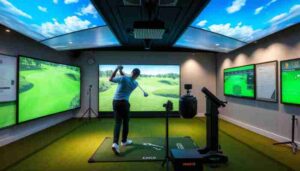
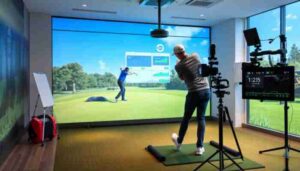
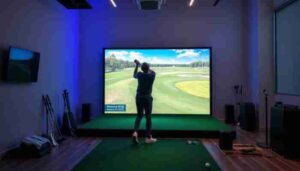
A simulator can only elevate your game when the room supports safe swings, clean visuals, and repeatable use. Ceiling height, depth, width, and flow all matter. A good room fit makes the simulator easier to trust and easier to enjoy.
3. A visual setup that feels believable
The image layer matters because it affects focus, immersion, and how accurate the simulator experience feels. A better home simulator room usually depends on a cleaner relationship between
simulator screens,
short throw projectors,
and the space itself.
4. Software that fits the way you play
Not every golfer wants the same thing from software. Some care most about practice modes and data review. Others care more about course play, family use, or a more immersive environment. A better simulator setup is the one where the software matches the real use case.
5. Low-friction everyday use
The best home indoor golf simulator is the one you actually use. If setup takes too much effort or the room feels frustrating, the long-term value drops quickly. Ease of use is one of the most underrated parts of performance improvement at home.
| Home simulator factor | Why it matters | What goes wrong without it |
|---|---|---|
| Launch monitor choice | Defines feedback quality | Practice becomes less useful |
| Room fit | Supports safe, repeatable use | The setup feels awkward or limiting |
| Visual setup | Improves immersion and clarity | The simulator feels less convincing |
| Software fit | Matches goals and play style | Features go underused |
| Ease of use | Supports long-term consistency | The simulator becomes a chore |
Who Benefits Most from a Home Indoor Golf Simulator?
Golfers who want more reps without more travel
If the main problem is not having enough time to visit the range or course, a home simulator can be a major upgrade. It turns short windows of time into real golf sessions.
Players working on technique and consistency
Home simulators are especially valuable when a player wants feedback they can use repeatedly. That makes them a strong fit for golfers focused on swing work, strike quality, and repeatable progress.
Families or households that want indoor golf access
For some buyers, the value is not only performance. It is also entertainment, flexibility, and shared use. In the right room, a home simulator can be both a practice tool and a year-round indoor golf experience.
Golfers planning a longer-term home setup
A home simulator becomes more compelling when the buyer already knows indoor golf will be a regular part of life. That is when the setup starts to feel less like a purchase and more like a long-term training environment.
A home simulator is often a strong fit when…
- you want indoor golf access every week
- you care about repeatable practice
- you have a room that can support it
- you want long-term convenience
A simpler path may be better when…
- space is limited
- you mainly want lighter practice
- you are not ready for a full room build
- you want lower setup friction first
When a Full Home Simulator Makes More Sense Than a Simpler Setup
Not every golfer needs a full room right away. Some do better starting with a lighter launch-monitor-led setup. But once you want stronger visuals, better structure, more repeatable use, and a fuller indoor golf environment, the case for a complete home simulator becomes much stronger.
That is often the moment when buyers start thinking less about individual components and more about the total experience: enclosure, screen, projector, software, hitting area, and how the whole room works together.
| Need | Better path | Why |
|---|---|---|
| Quick practice with lower complexity | Portable launch monitor path | Easier entry and room flexibility |
| Fuller indoor golf experience | Complete home simulator | Better visual and room integration |
| Long-term at-home practice environment | Complete home simulator | Best total-use potential over time |
Common Mistakes That Stop Home Simulators from Helping
Best Next Step Based on Your Home Goal
If you want to compare the main simulator options first
Start with golf simulators.
If you want a simpler home entry point
Compare portable launch monitors first.
If budget is your biggest question
Review the full setup cost guide.
If you are still early in the decision process
Read the beginner guide before choosing the path.
FAQ
Are indoor golf simulators good for home use?
Yes, especially when the setup fits the room properly and matches the golfer’s goals. Home simulators work best when they reduce friction and make repeatable practice easier.
What is the best indoor golf simulator for home?
The best home simulator is the one that fits your room, budget, and practice goals. For many golfers, a well-balanced setup is more useful than the most expensive option.
How much do indoor golf simulators cost?
Costs vary widely based on the launch monitor, screen, projector path, software, and room build. That is why the total setup cost usually matters more than the headline product price alone.
Can a home simulator really improve your golf game?
It can, especially when it supports consistent practice, useful feedback, and a setup that is easy to use often. Improvement usually comes from repeatable sessions, not just from owning the equipment.
Is a portable launch monitor enough for home golf?
For some golfers, yes. It can be the best first step when you want simpler home practice without building a full room immediately. A complete simulator makes more sense when you want stronger visuals and a fuller indoor golf environment.
What is the biggest mistake with home indoor golf simulators?
The biggest mistake is choosing a setup that looks impressive but does not fit the room or the real use case. A simulator only helps long term when it works smoothly in everyday life.
Conclusion
Indoor golf simulators can absolutely elevate golf at home, but the real value does not come from the category name alone. It comes from the quality of the fit between the room, the technology, and the player’s real goals.
The strongest home setups make golf easier to practice, easier to enjoy, and easier to keep improving over time. When the simulator works as a complete system instead of just a list of parts, it becomes one of the most useful golf investments a player can make.

Ethan Reynolds is a passionate writer and enthusiast in the world of indoor golf simulators. With a keen eye for technology and a deep understanding of golf dynamics, he explores the intersection of sports performance and innovative simulation tools. Through his engaging articles, Ethan provides valuable insights and tips for golfers at all levels, helping them enhance their game while enjoying the convenience of home-based training.
Discussion
4 Responses
Your insights on the nuances of setting up an effective home indoor golf simulator really resonate with me. It’s intriguing how much consideration goes into the balance of technology, space, and personal preference. I’ve often thought that the essence of golf, whether on a course or indoors, is not just in hitting the perfect shot but also in creating an environment that encourages improvement and enjoyment.
You’ve nailed an important point about the balance in home golf setups. I recently invested in a portable launch monitor, and it was a game changer for my practice routine. I did a ton of research to find one that not only fits my budget but also matches my space and what I want out of practice. It’s easy to get lost in the flashy tech and big-name brands, but I found that a solid, versatile unit that offers good feedback was really what I needed.
Your insights into the balance of quality and practicality in home indoor golf setups really resonate. I recently converted a small room in my house into a golf practice area and found that focusing on the right launch monitor and software truly made a difference. It’s not just about hitting the ball; being able to analyze my swing data has helped improve my performance more than I expected.
This is such an interesting topic! I totally agree that the best indoor golf setups aren’t just about having the fanciest gear. A few months ago, I helped a friend set up a simulator in their garage, and we focused on optimizing the space rather than just splurging on the best technology. We ended up with a smaller launch monitor that fit the room perfectly, and it made a huge difference in their consistency and enjoyment.